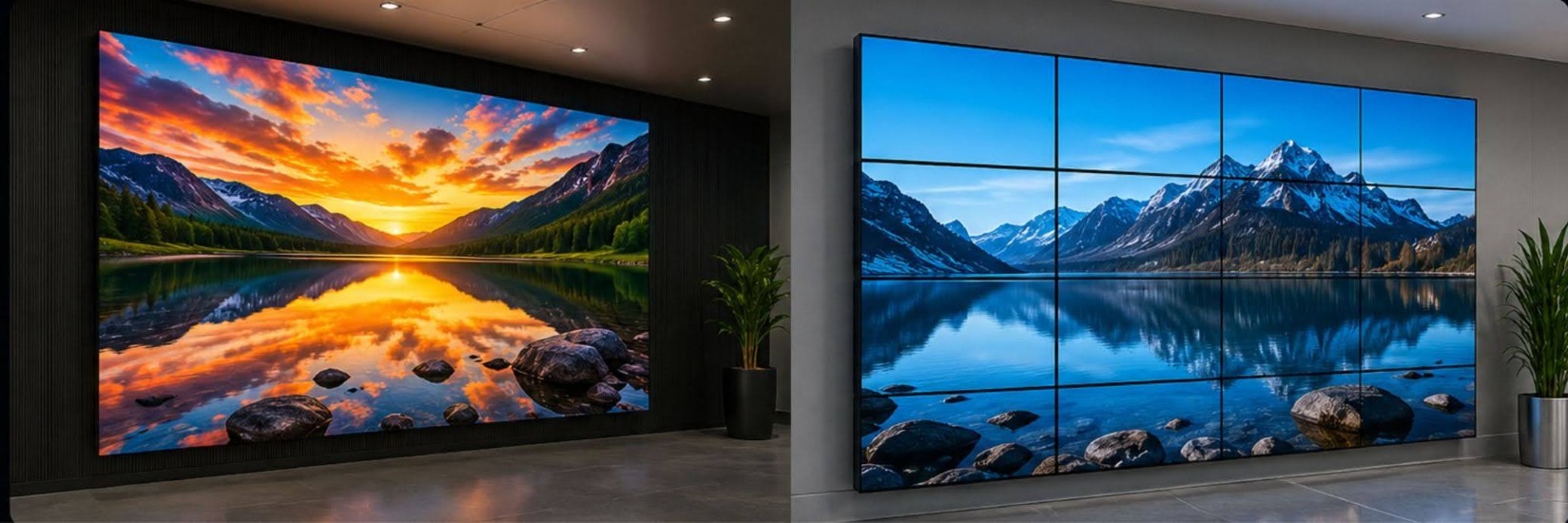
A video wall is a large-scale display formed by joining multiple panels to create a single continuous screen, and it can use either LED or LCD technology. LED video walls use connected light-emitting modules to create a seamless, borderless canvas, while LCD video walls are made by tiling individual LCD panels, which means visible bezel lines between each screen. The right choice for your Malaysian business depends on viewing distance, the size of your space, and how much detail your content needs to appear at close range.
If you’re planning a video wall for a lobby, control room, retail space, or event in Malaysia, here’s what actually matters when choosing between the two.
What’s the Difference Between an LED and LCD Video Wall?
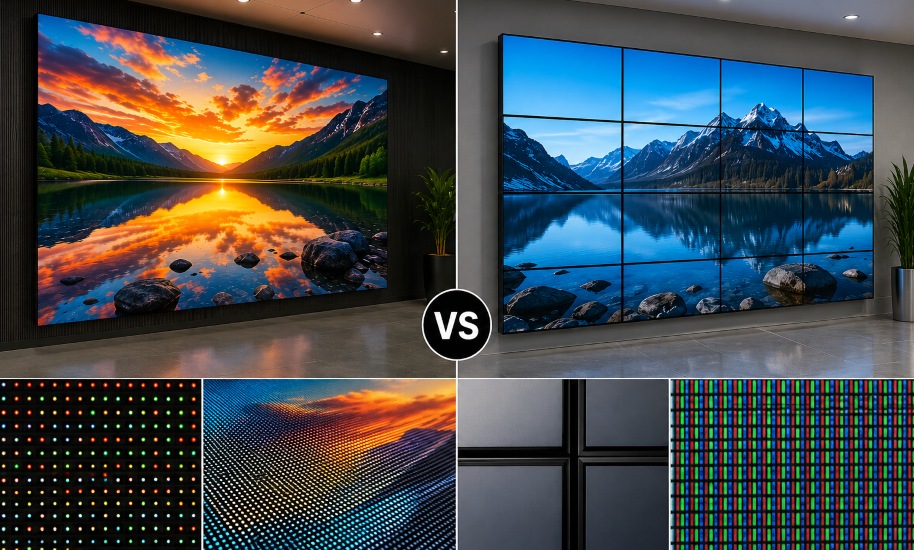
Both technologies can be used to build an immersive, large-format display; the difference is in how each one is constructed and how it performs.
An LED video wall is built from individual LED modules or cabinets that connect directly to one another. There’s no glass panel or frame around each section, just rows of light-emitting diodes that combine to form the image. Because there’s nothing physically separating one module from the next, the result is a continuous canvas with no visible seams.
An LCD video wall is built by mounting multiple LCD screens, the same display technology used in TVs and computer monitors, side by side in a grid. Each screen has its own frame, called a bezel, and when several screens are tiled together, those bezels create thin lines across the overall image.
This is a more specific comparison than choosing a display for general signage. If you’re deciding between LED and LCD for a single screen, menu board, or shop-front display rather than a multi-panel wall.
Bezels, Seamlessness & Visual Impact
The single biggest visual difference between the two comes down to the bezel.
LED video walls have no bezels at all, since the modules connect directly without any frame in between. This makes them the better choice when you want one uninterrupted image — a brand visual, a piece of artwork, or a single video stretched across the entire wall without anything breaking it up.
LCD video walls do have visible bezels, and the size of those bezels affects how much they interfere with your content. Premium ultra-narrow-bezel LCD panels exist and can reduce the bezel gap to a few millimetres, but there will still be a faint grid across the image. This matters less if your content is naturally divided into sections, for example, separate camera feeds in a security control room, or different dashboards in an operations centre, and matters a lot more if you’re displaying one large, continuous visual.
Understanding Pixel Pitch & Viewing Distance
If you’re comparing LED video walls, you’ll come across the term pixel pitch almost immediately, and it’s worth understanding before you start getting quotes.
Pixel pitch is the distance, in millimetres, between the centre of one LED pixel and the centre of the next. A smaller pixel pitch means the pixels are packed more tightly together, which gives you a sharper image, but it also means a higher cost per square metre, since more LEDs are needed to cover the same area.
The pixel pitch you need depends entirely on how close your audience will be standing. A simple rule of thumb used across the industry: take the pixel pitch in millimetres and multiply it by roughly 3 to 10 to estimate the minimum comfortable viewing distance in metres, depending on the exact display and content type. A wall with a 4mm pixel pitch is built for viewers standing several metres away, a mall atrium or stage backdrop, for instance, while a control room wall viewed from just 1–2 metres away would need a much finer pitch, often under 1.5mm, to avoid the image looking pixelated up close.
This is also where LCD has a natural advantage: because LCD panels pack pixels far more densely than even fine-pitch LED, they remain sharp at very close viewing distances without needing the premium pricing that ultra-fine-pitch LED commands.
Resolution & Image Clarity
Following on from pixel pitch, resolution and clarity tend to favour different technologies depending on viewing distance.
LCD video walls deliver excellent clarity up close. Because the pixels are densely packed within each panel, text, fine graphics, and detailed imagery remain sharp even when viewers stand right in front of the screen. This makes LCD a strong choice for control rooms, data-heavy dashboards, and any setting where people are reading detailed content at close range.
LED video walls are built for scale and distance. At a typical viewing distance, the image looks vivid, bright, and seamless but because LED pixels are physically larger and more widely spaced than LCD pixels, getting close to the wall will make individual pixels more noticeable, especially at wider pitches. For large open spaces where people view the wall from several metres away, this isn’t a drawback at all.
Cost & Total Cost of Ownership for Multi-Panel Walls
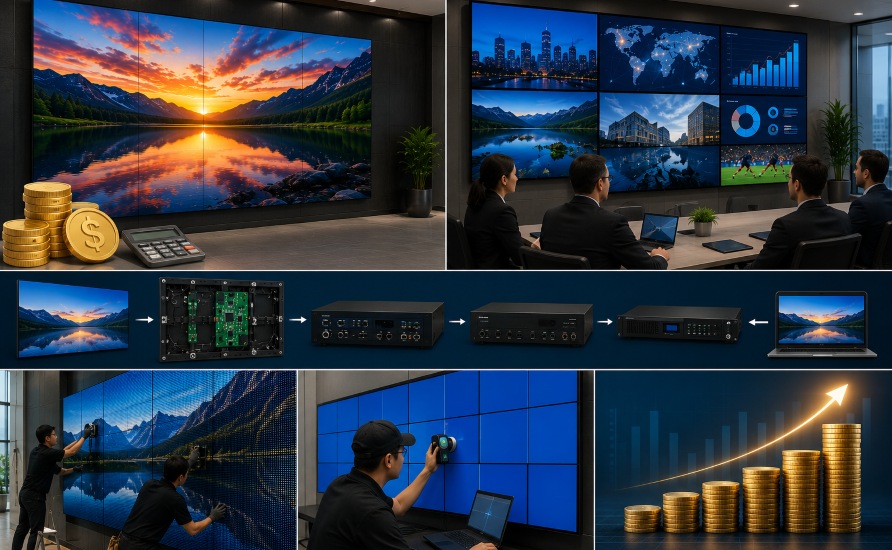
Video wall pricing differs from that of a single signage screen, mainly because of the additional requirements needed to make multiple panels function as one display.
Both LED and LCD video walls require a video wall processor or controller, which manages how content is split, scaled, and synchronised across every panel. This is an additional cost on top of the panels themselves, and the more advanced your content needs (multiple input sources, real-time data feeds, video switching), the more capable and costly the processor needs to be.
Installation and calibration also add more to the total cost than a single-screen setup. LED walls require careful alignment of every module to keep the surface flat and seamless, while LCD walls need colour and brightness calibration across panels to avoid visible inconsistencies between screens. Larger walls with more panels naturally take longer to install and calibrate properly.
For a broader breakdown of LED display costs and how to think about return on investment for your business, see our LED display costs and ROI guide.
Maintenance Considerations for Video Walls
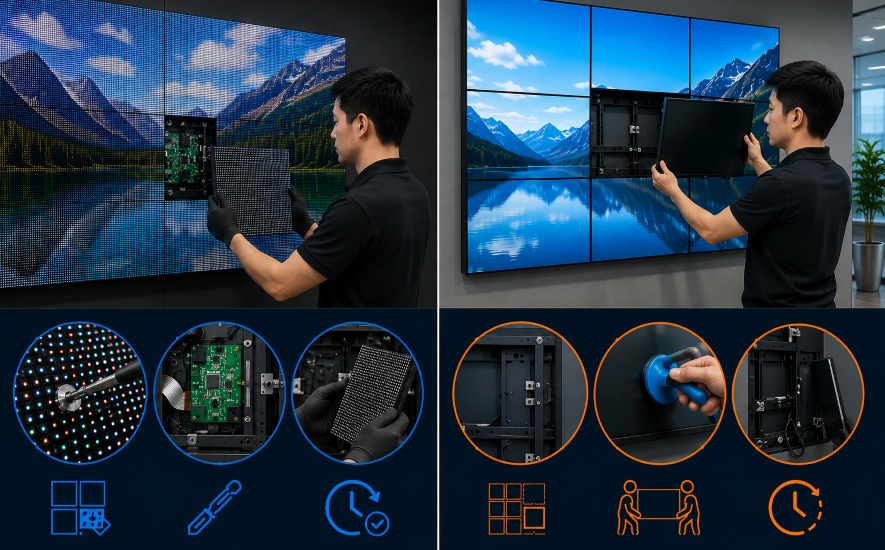
Because a video wall has many more components working together than a single screen, ongoing maintenance should be planned from the start.
LED video walls are generally easier to maintain at the component level. If one module develops a fault, it can usually be swapped out individually without taking down the rest of the wall. Over time, colours or brightness across a large LED wall can drift slightly between modules, which is corrected through periodic software calibration rather than hardware replacement.
LCD video walls carry a different set of risks. If a panel’s backlight begins to dim or fail, the entire panel typically needs to be replaced rather than a smaller component — a larger and more costly fix than an LED module swap. LCD panels showing static content for long periods are also more prone to burn-in, a faint ghost image that can remain on screen, so content rotation matters more for LCD walls than LED ones.
Best Use Cases for Video Walls in Malaysia
- Corporate lobbies and boardrooms: A seamless LED video wall makes a strong first impression in a reception area or executive boardroom, where brand visuals and presentations benefit from an uninterrupted canvas.
- Control rooms and operations centres: LCD video walls are a common choice here, since operators sit close to the wall and need to read detailed dashboards, maps, or live camera feeds clearly, and the bezel lines are less disruptive when content is already divided into separate panes.
- Retail flagship stores and shopping mall atriums: LED video walls create high-impact visuals that draw attention from a distance, ideal for mall atriums, store windows, and experiential retail spaces. For a closer look at how shopping malls in Malaysia use this, see our guide to the benefits of indoor LED video walls for shopping malls.
- Events, conferences, and exhibitions: Both technologies are used at events, but LED tends to be the default for stage backdrops, conference keynote screens, and exhibition booths, largely because it can be configured into custom shapes and sizes and viewed comfortably from a distance across a hall.
LED or LCD Video Wall: Which Should You Choose?
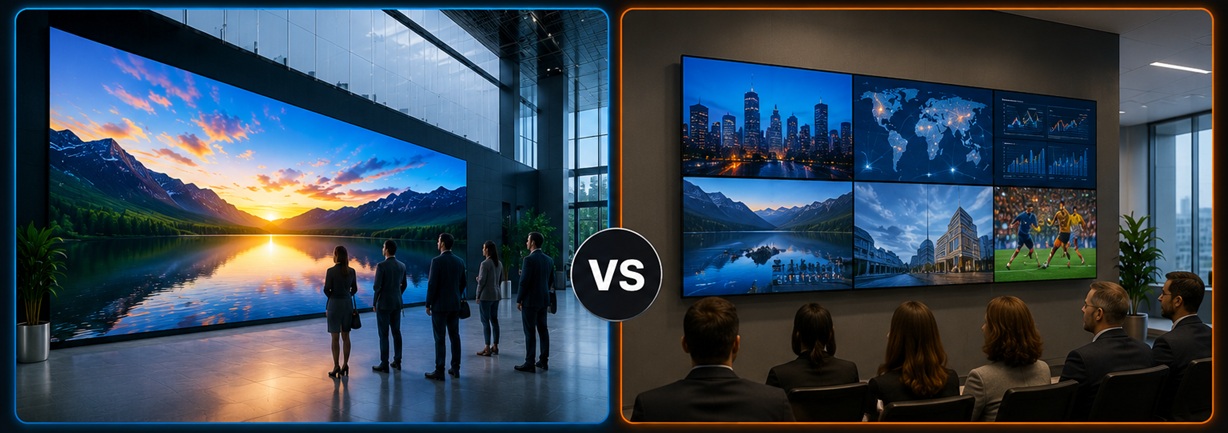 As a quick way to summarise the decision:
- Choose LED if your wall will be viewed from a distance, needs to display a single seamless image, will be used in a brighter or larger space, or requires a custom shape or size.
- Choose LCD if your audience sits close to the wall, you need maximum image sharpness for detailed content, your content is naturally divided into separate sections, and budget is a primary concern.
Conclusion & Final Recommendation
Both LED and LCD video walls can deliver an impressive, large-format display — the right choice simply depends on how far your audience will be standing, how detailed your content is, and what kind of space you’re building it for. LED video walls suit large, distance-viewed spaces where seamlessness and visual impact matter most, while LCD video walls suit close-viewing, detail-heavy environments like control rooms.
Need help deciding for your space? Every video wall project has different viewing distances, lighting conditions, and content needs. Contact us for a complimentary consultation with our LED display specialists, or explore our indoor LED display range and LED rental options to find the right fit for your business.


