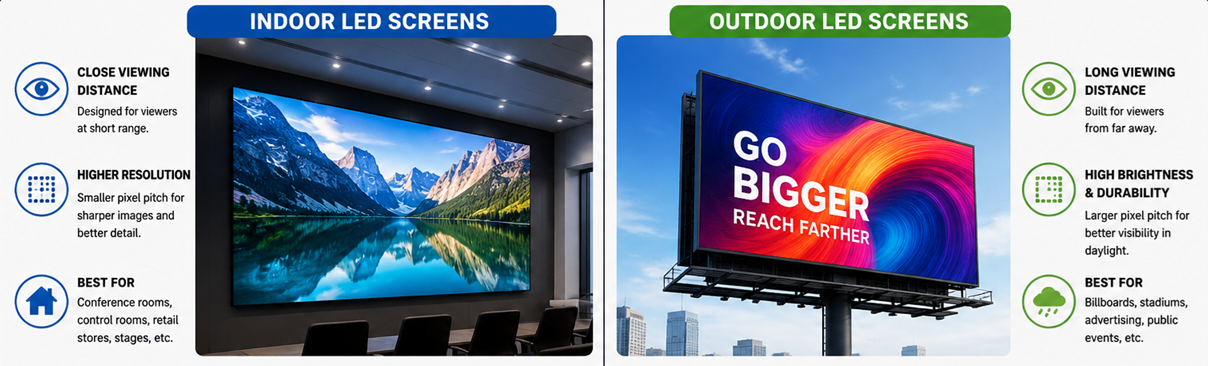
Choosing the right LED screen is not only about size, brightness, or price. One of the most important technical factors to consider is pixel pitch.
Pixel pitch affects how clear your content looks, how close people can stand to the screen, and how suitable the display is for indoor or outdoor use. If the pixel pitch is too large for close viewing, the image may appear pixelated. If the pixel pitch is too fine for a far-distance outdoor screen, the project may become unnecessarily expensive without adding much practical value.
For Malaysian businesses, this is especially important because LED screens are used in a wide range of environments. A retail store in a shopping mall, a corporate lobby, an outdoor billboard, and a public event screen all need different specifications.
Understanding pixel pitch helps businesses choose the right screen for their audience, location, content type, and budget. Whether you are planning an indoor or outdoor LED display, the right pixel pitch can make a major difference in performance and long-term value.
What Is Pixel Pitch?
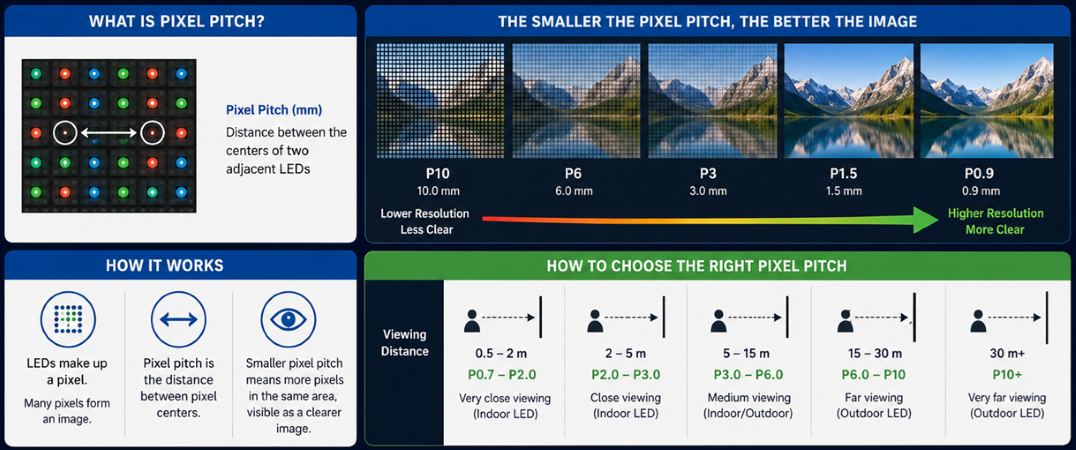
Pixel pitch refers to the distance between the centre of one LED pixel and the centre of the next LED pixel. It is usually measured in millimetres and shown as P followed by a number, such as P1.5, P2.5, P3.9, P5, or P10.
For example, a P2.5 LED screen means the distance between each pixel is 2.5mm. A P5 LED screen means the distance between each pixel is 5mm.
The smaller the pixel pitch, the closer the pixels are to each other. This usually creates a sharper and more detailed image, especially when people are standing close to the screen.
The larger the pixel pitch, the further apart the pixels are. This may still look clear from a longer distance, but it may appear less sharp when viewed up close.
In simple terms:
- Smaller pixel pitch = clearer image at close distance
- Larger pixel pitch = suitable for longer viewing distance
- Finer pixel pitch = usually higher cost
- Wider pixel pitch = usually more cost-effective for large outdoor screens
This is why pixel pitch should not be selected based on “the smallest number” alone. The right choice depends on where the screen will be installed and how far the audience will stand from it.
For an indoor LED display, viewers are usually closer to the screen, so a finer pixel pitch is often needed. For an outdoor LED display screen, viewers are usually further away, so a larger pixel pitch may be suitable depending on the viewing distance and screen size.
Indoor vs Outdoor LED Requirements
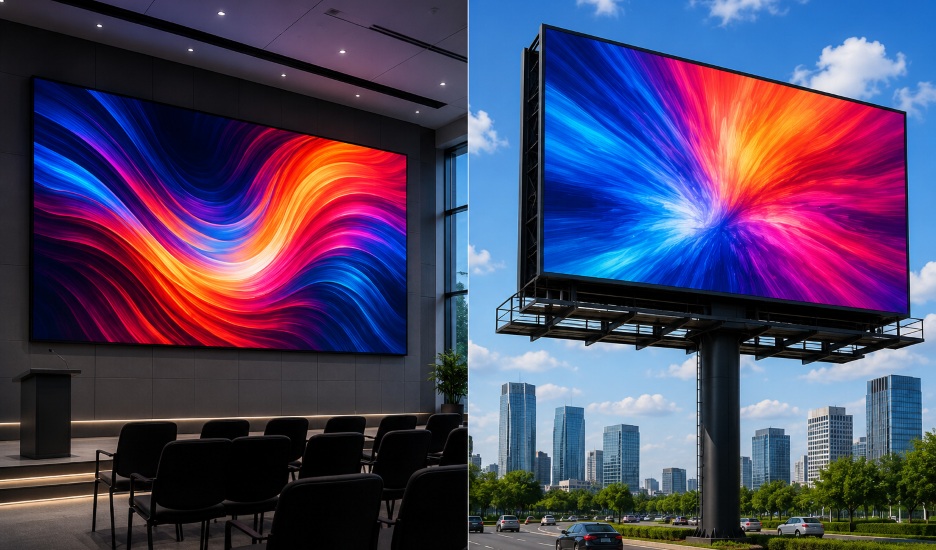
Indoor and outdoor LED screens are built for different environments. This means the pixel pitch, brightness, protection level, and viewing distance requirements are not always the same.
Indoor LED displays are typically installed in retail stores, shopping malls, corporate offices, showrooms, control rooms, event halls, and hotel lobbies. These screens are often viewed at close range, so image clarity is very important.
Common indoor LED display considerations include:
- Closer viewing distance
- Lower ambient light compared to outdoor spaces
- Sharper image quality for text, graphics, and videos
- Comfortable brightness for indoor viewing
- Better detail for branding, presentations, and promotional content
Because indoor viewers are usually closer, businesses often choose finer pixel pitches such as P1.5, P1.8, P2, P2.5, or P3, depending on the screen size and viewing distance.
Outdoor LED display screens have different requirements. They are exposed to sunlight, weather, dust, heat, and longer viewing distances. Outdoor screens usually require higher brightness and stronger protection than indoor screens.
Common outdoor LED display screen considerations include:
- Longer viewing distance
- Higher brightness to remain visible under sunlight
- Weather-resistant design
- Durability for rain, heat, and dust exposure
- Larger screen size for visibility from roads, open areas, or building façades
For outdoor screens, wider pixel pitches such as P4, P5, P6, P8, or P10 may be suitable depending on how far viewers are from the screen. A large outdoor billboard does not always require a very fine pixel pitch, since most viewers are far away.
This is where many businesses overspend. They may request the finest pixel pitch available, but if the screen is viewed from a long distance, the extra clarity may not be noticeable to the audience. A better approach is to match the pixel pitch to the actual viewing environment.
Calculating Viewing Distance
Viewing distance is one of the easiest ways to estimate the right pixel pitch for an LED screen.
As a general guide, the minimum comfortable viewing distance in metres is roughly equal to the pixel pitch in millimetres.
Basic formula:
Minimum viewing distance = Pixel pitch in mm × 1 metre
For example:
- P2 LED screen = suitable from around 2 metres and above
- P2.5 LED screen = suitable from around 2.5 metres and above
- P3 LED screen = suitable from around 3 metres and above
- P5 LED screen = suitable from around 5 metres and above
- P10 LED screen = suitable from around 10 metres and above
This formula is not a strict rule, but it gives a practical starting point when comparing LED screen specifications.
For more comfortable viewing, especially for video content or large-format displays, some businesses may use a slightly longer distance estimate.
Comfortable viewing distance = Pixel pitch in mm × 2 to 3 metres
For example, a P3 screen may be comfortably viewed from around 6 to 9 metres, depending on the content and screen size.
Another simple way to think about it is this:
- Short-distance viewing: Choose a smaller pixel pitch for clearer details.
- Long-distance viewing: A larger pixel pitch may be enough and more cost-effective.
For short-distance viewing, such as a retail display inside a store, a fine pixel pitch is usually better because customers may stand close to the screen. If the display shows product videos, prices, menus, or promotional text, clarity matters.
For long-distance viewing, such as an outdoor screen facing traffic or a building façade, the audience may view the screen from several metres away. In this case, a wider pixel pitch can still deliver strong visibility while helping manage the project budget.
Businesses should also consider the type of content shown on the screen. Text-heavy content, detailed visuals, close-up product images, and corporate presentations usually need better resolution. Large graphics, simple advertisements, or long-distance billboard visuals may not need the same level of detail.
Case Examples in Malaysia
Different business environments in Malaysia require different LED screen specifications. The right pixel pitch depends on the audience, location, lighting conditions, and purpose of the display.
Retail Stores and Shopping Malls
Retail stores often use LED displays for promotions, branding, product videos, and campaign visuals. Since customers may walk close to the screen, a finer pixel pitch is usually recommended.
For example, an indoor LED display inside a boutique, electronics store, supermarket, or shopping mall kiosk may need a pixel pitch such as P1.8, P2, P2.5, or P3 depending on the viewing distance and screen size.
If the screen is placed behind a cashier counter or on a feature wall, customers may view it from only a few metres away. In this case, image clarity is important because blurry text or pixelated graphics can affect the customer experience.
A well-selected indoor LED display can help retail businesses:
- Promote offers more clearly
- Improve brand visibility
- Display product videos
- Attract shoppers from nearby walkways
- Reduce reliance on printed posters
Public Spaces and Outdoor Areas
Outdoor LED screens are commonly used in public spaces, on roadsides, on building exteriors, at transport hubs, at event areas, and in commercial developments.
In these environments, the screen is usually viewed from a longer distance. Brightness and durability are often more important than extremely fine pixel pitch.
For example, an outdoor LED display screen facing a road or open public area may use P4, P5, P6, P8, or P10, depending on the viewing distance. If the audience is far away, a wider pixel pitch may still appear clear while keeping the investment more practical.
Outdoor LED screens also need to handle Malaysia’s weather conditions, including heat, rain, humidity, and sunlight. This means that brightness level, waterproof rating, structural support, and maintenance access should be considered alongside pixel pitch.
A suitable outdoor LED display screen can help businesses:
- Increase visibility from a distance
- Promote campaigns in high-traffic areas
- Display announcements or public information
- Strengthen brand exposure
- Support events, advertising, and commercial communication
Corporate Offices and Indoor Lobbies
Corporate offices often use LED screens in reception areas, boardrooms, meeting rooms, experience centres, and presentation spaces.
In these settings, viewers may stand or sit quite close to the screen. The display may also show detailed content such as company videos, charts, presentation slides, branding visuals, or visitor information.
As a result, corporate indoor LED screens typically benefit from a finer pixel pitch. A screen with P1.5, P1.8, P2, or P2.5 may be suitable depending on the room size and viewing distance.
For example, a boardroom LED screen used for presentations should be clear enough for text, graphs, and images. A lobby LED screen may need to look professional from both close and medium viewing distances.
Choosing the right pixel pitch in a corporate environment helps create a sharper and more polished impression. It also supports better communication during presentations, events, and client visits.
Conclusion
Pixel pitch plays a major role in LED screen performance. It affects image clarity, viewing distance, cost, and overall suitability for the installation environment.
For indoor LED displays, a finer pixel pitch is usually preferred because viewers are closer and image detail is more important. For outdoor LED display screens, the viewing distance is usually longer, so a wider pixel pitch may be suitable and more cost-effective.
The best choice depends on several factors, including screen location, brightness requirements, ambient light, content type, viewing distance, and budget. Instead of choosing the smallest available pixel pitch, businesses should select the pixel pitch that best matches how the screen will actually be viewed.
A well-planned LED screen can improve visibility, communication, customer engagement, and brand presentation. By understanding pixel pitch before purchasing, Malaysian businesses can make a more practical and cost-effective decision.
If you are planning an indoor project, explore our indoor LED display solutions to find a screen that suits close-viewing environments. For outdoor advertising, building façades, or public-facing displays, view our outdoor LED display screen options for high-brightness and long-distance visibility.


