Ask three LED screen rental companies in Malaysia for a quote, and you’ll usually get three different numbers. None of them will make clear what’s actually included.
And before price even comes into it, most event organisers are stuck on a more basic question: what size screen do you actually need for your venue and guest count?
This guide answers both. We’ll cover how rental pricing works in Malaysia, what’s typically bundled into a quote versus billed separately, how to size a screen to your event, and the questions worth asking before you sign anything.
How LED screen rental is priced in Malaysia
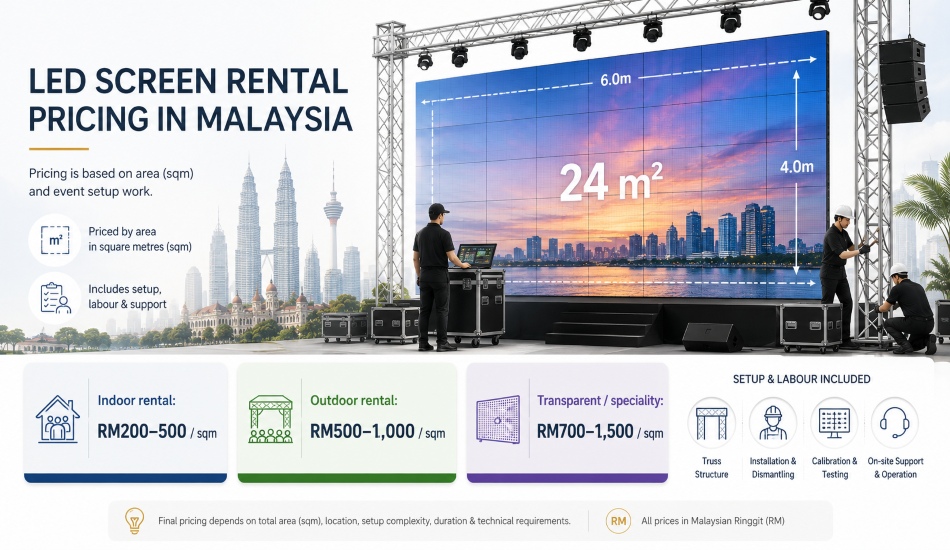
LED screen rental in Malaysia is priced by area, in square metres (sqm), per day. It is not priced as a flat fee per screen.
That’s because the real cost driver isn’t the screen itself. It’s the number of LED panels, the structure needed to support them, and the labour to rig, calibrate and dismantle it all. All of these scale with size.
Typical ranges seen across Malaysian vendors:
- Indoor rental: Roughly RM200 to 500 per sqm for the first day
- Outdoor rental: Roughly RM500 to 1,000 per sqm for the first day. This reflects the extra brightness and weatherproofing required
- Transparent or speciality LED: Higher again, often RM700 to 1,500 per sqm
- Subsequent days: Many vendors price additional days at around half the first-day rate. Transport, rigging and calibration are mostly one-off costs
Within each range, three things move the price. A finer pixel pitch costs more. Multi-day events usually get a better per-day rate. And venues further from the vendor’s base cost more to reach.
These figures are a starting point for budgeting, not a firm quote. Get in touch for pricing based on your specific event.
What’s included in a rental quote, and what isn’t
Every quote should spell out what’s bundled and what isn’t, but not all of them do it upfront. Before comparing prices between vendors, check both sides of this list.
Usually included:
- LED panels for the agreed screen size
- Basic video processor / sending card
- Delivery to venue (within a standard radius)
- On-site setup and dismantling
- Cabling and standard rigging hardware
Often charged separately. Ask about these before you compare quotes:
- Truss or ground-support structure for large or free-standing screens
- On-site technician standby for the duration of the event
- Backup generator, for outdoor events without reliable power access
- Content conversion or resizing to match your screen’s exact resolution
- Spare panel float, in case a module fails mid-event
- SST (6%)
- Overtime charges if the event runs past the agreed teardown time
- Venue loading bay or access charges (some hotels and convention centres bill these directly)
A quote that looks cheaper on paper can end up more expensive once these are added. Always ask for a full, itemised breakdown rather than comparing bare per-sqm rates.
What size LED screen do you need?
Screen size should be driven by your furthest viewer, not by what looks most impressive in photos. Oversizing wastes the budget. Undersizing means people at the back can’t read anything on screen.
Use the table below as a starting point, then adjust for your specific room shape and stage layout.
| Guest count | Typical venue | Suggested screen size | Approx. area |
|---|---|---|---|
| Up to 100 | Small function room, intimate wedding | 3m × 2m | ~6 sqm |
| 100-300 | Hotel ballroom, corporate dinner | 4m × 2.5m | ~10 sqm |
| 300-800 | Convention hall, seminar, AGM | 6m × 3m | ~18 sqm |
| 800-2,000 | Concert, large roadshow | 8m × 4m | ~32 sqm |
| 2,000+ (outdoor) | Festival, stadium, open field | 10m × 5m or larger | 50+ sqm |
Two conventions are worth knowing before you request a size.
- The viewing distance rule. For text-heavy content, such as agendas, name lists or small-font slides, keep your farthest viewer within about 6 to 8 times the screen height. For video and general content, that stretches to about 10 to 15 times the height. This is standard AV industry guidance.
For example, a 2.5m-tall screen stays readable for text up to about 15 to 20m away. Beyond that distance, either use a bigger screen or keep the content simple.
- The cabinet increment rule. LED screens are built from standard rental cabinets, almost always either 500mm × 500mm or 500mm × 1000mm. That means a screen can only be built in half-metre steps, not any dimension you like. If you ask for “12ft by 8ft,” expect your vendor to round that to the nearest cabinet grid. Knowing this in advance avoids a confusing back-and-forth once the quote comes in. For more on how pixel density affects clarity at different distances, see our pixel pitch guide.
Which pixel pitch to rent
Pixel pitch is the distance between LED clusters, measured in millimetres. It determines how close your audience can stand before the image looks grainy. For rentals, the common options are:
| Pixel pitch | Comfortable viewing distance | Typical use |
|---|---|---|
| P2.5 | From ~2.5m | Indoor stage backdrops, close-up corporate events |
| P2.9-P3.9 | From ~3-4m | Weddings, conferences, most indoor events |
| P4.8 | From ~5m | Indoor/outdoor hybrid, larger halls |
| P6-P10 | From ~8m+ | Outdoor concerts, festivals, stadium screens |
Indoor vs outdoor rental: what changes the price
Outdoor rentals cost more than indoor ones at the same screen size, mainly for two reasons.
- Brightness. Indoor screens typically run at 800 to 1,500 nits, which is enough for a dim ballroom. Outdoor screens need to compete with daylight. They often run at 4,000 to 6,000 nits or higher, and brighter panels cost more to build and to power.
- Weatherproofing. Outdoor screens need an IP65-rated (or higher) enclosure to handle Malaysia’s rain and humidity. They also need wind-rated rigging if the screen is elevated or free-standing.
Two more things affect outdoor cost. The first is power. A dedicated generator is often needed for fields, car parks or open grounds without reliable venue power. The second is rain contingency. Confirm this with your vendor before the event, not during it.
LED screen rental for weddings
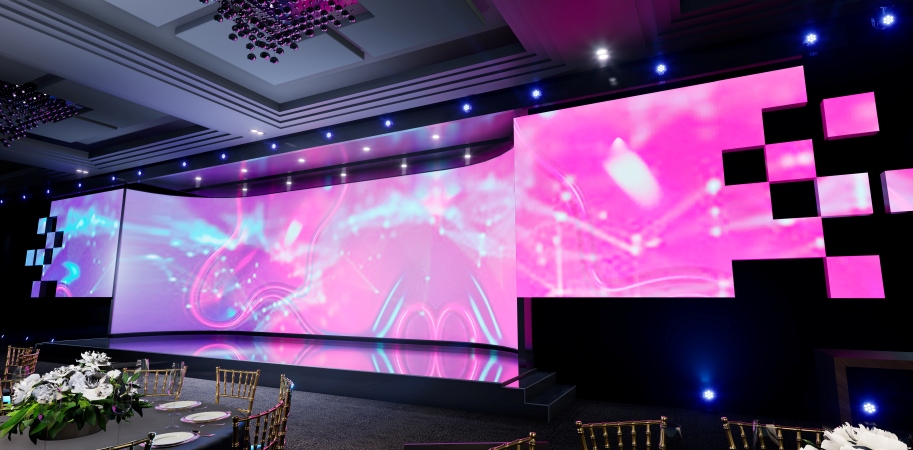
For couples and planners, this is usually less about specs and more about how the screen fits the room.
- Positioning: Most wedding screens sit directly behind or beside the main stage, angled so they’re visible from every table without competing with the couple for attention.
- Ceiling height: Hotel ballrooms often cap screen height because of ceiling clearance and chandelier placement. Confirm this with the venue before finalising screen dimensions, not after.
- Content: Live camera feed, pre-wedding montage, and a simple welcome or name display are the three most common uses. Each has different resolution and connectivity requirements, so mention all three when you request a quote.
- Timing: Popular dates during peak wedding season, roughly August to December, get booked out for screens much like venues do. Confirming 6 to 8 weeks ahead is the safer window.
Corporate events, roadshows and exhibitions
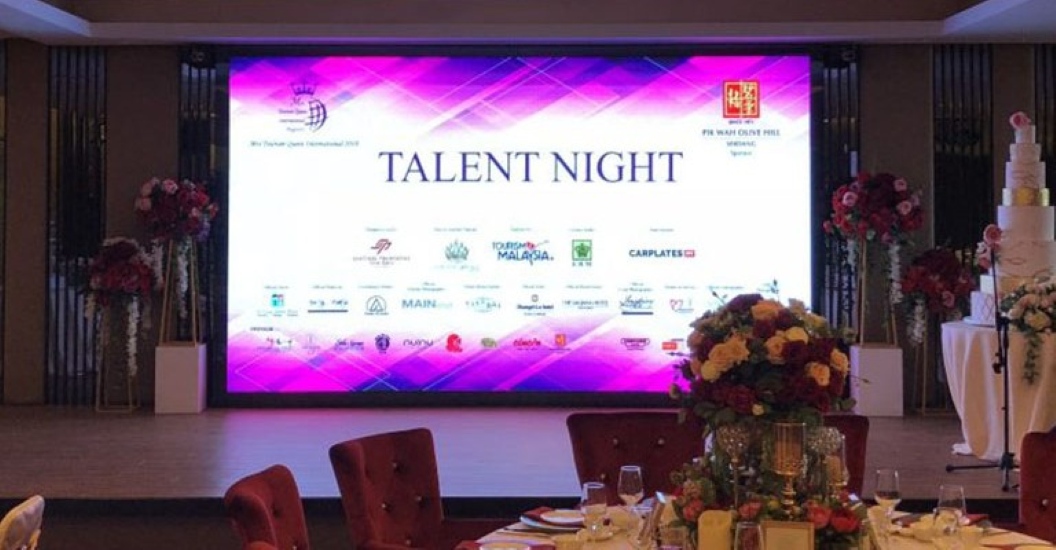
For product launches, AGMs, town halls and exhibition booths, the priorities shift.
- Livestream and recording. If the event will be recorded or streamed, confirm the vendor can output a clean feed, not just what’s shown in the room. This sometimes needs separate equipment.
- Dual-screen setups. Larger conferences often run a main stage screen plus one or two confidence monitors or side screens for overflow seating.
- Branding integration. Roadshow and exhibition screens are frequently built into a branded structure or booth. Confirm early whether the screen or the structure is designed first, since this affects both cost and lead time.
- Lead time. Corporate bookings tend to be planned further out than weddings. Venue confirmation and branding sign-off often lag behind, so lock in the screen size early even if the content isn’t finalised yet.
7 questions to ask before you sign a rental quote
- Is a technician on site for the full event, or just for setup and teardown? A mid-event fault with nobody there to fix it is one of the most common rental complaints.
- What’s the policy if a panel fails? Ask whether spare panels are on hand and how quickly a swap happens if one goes dark mid-event.
- Who supplies power, and is a backup generator included for outdoor events?
- What’s the setup and teardown window, and does the venue charge separately for early access or late loading?
- What content format and resolution do you need from me, and by when? Late content changes are a common source of last-minute stress.
- Is SST included in the quoted price, or added afterwards?
- What’s the policy if the event is postponed or cancelled? Confirm rebooking and refund terms before paying a deposit.
Ready to plan your event screen?
Send us your venue, guest count and event date. We’ll recommend the right size, pixel pitch and setup, with a clear, itemised quote so there are no surprises later. Get a free consultation or browse our past event installations.
Frequently Asked Questions
How much does it cost to rent an LED screen in Malaysia?
Indoor rentals typically range from RM200 to 500 per sqm for the first day. Outdoor rentals run RM500 to 1,000 per sqm, with subsequent days usually priced lower. Final cost depends on screen size, pixel pitch and what’s included. Contact Interlight for a quote based on your event.
What size LED screen do I need for a wedding of 300 guests?
For a ballroom hosting around 300 guests, a screen of roughly 4m × 2.5m (about 10 sqm) is a common starting point. The right size still varies with room shape and stage position.
Is P3 or P4 better for LED screen rental?
P2.9 to P3.9 suits most indoor events where guests sit within 3 to 4m of the screen. P4.8 and above works better for larger halls or hybrid indoor and outdoor setups where viewers sit further back.
Do I need a technician on-site during my event?
For anything beyond a small static display, yes. Most vendors recommend on-site standby for events with live feeds, multiple content changes, or any outdoor element where weather could affect performance.
How far in advance should I book an LED screen rental?
2 to 4 weeks is usually enough for a standard indoor event. 6 to 8 weeks is safer during peak wedding season or for large outdoor events that need structural approval.
Can I rent a curved or transparent LED screen?
Yes, both are available for rent. They’re typically priced higher than standard flat panels because of their specialised cabinets. Contact us to check availability for your event date.
Should I rent or buy if I need a screen regularly?
For a single event, renting is almost always cheaper upfront. If you need a screen repeatedly, buying can pay for itself within a year or two.


