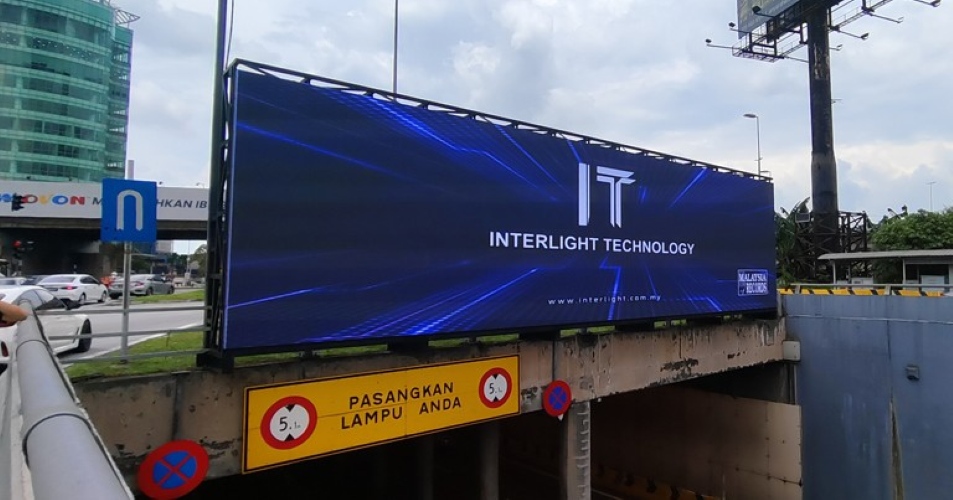
Most guides to signboard licensing in Malaysia are written for shop owners putting up a fascia sign. An LED billboard or digital display falls into a different category, with its own application process and conditions; treating it like a regular shop sign is the most common reason applications are delayed.
This guide covers what changes when your display is LED or digital, what every council requires regardless of location, and how DBKL, MBPJ, MBSA and MPS specifically handle it.
Why an LED display needs a different licence than a shop signboard
DBKL issues six separate categories of advertising licence. Premise signboards, the fascia sign outside a shop, are one category. Outdoor displays such as billboards, LED screens, sky signs, wall ads, and gantry ads are a different category entirely, with their own application and conditions.
The same split shows up elsewhere. MBPJ publishes a dedicated guideline for outdoor displays (Garis Panduan Paparan Iklan Luaran), separate from its premise signboard rules. MPS routes billboards and LED displays through a distinct External Signboard Section, and its application form asks you to tick whether the display is static or digital LED. MBSA is the exception. It folds signboards, including LED displays, into a single composite licence alongside your business premise licence, but still names LED as its own display type within that licence.
The practical takeaway: if you search for “signboard licence” in Malaysia, most results cover premise signboards only. For an LED billboard or digital display, you want the outdoor display or LED-specific category at your council, not the general shop signboard guide.
Which council do you apply to?
Your application goes to whichever council governs the installation site, not your company’s registered address. DBKL covers Kuala Lumpur itself. Petaling Jaya falls under MBPJ. Shah Alam, including the HICOM-Glenmarie and Kota Kemuning industrial areas, falls under MBSA. Selayang, Batu Caves, Rawang, Gombak and Kepong fall under MPS.
If your site is in Subang Jaya, Klang, or another Klang Valley municipality outside these four, you’ll be dealing with a different local council entirely. It’s worth confirming the exact jurisdiction from the site address before you start gathering documents, since requirements and fees follow a similar pattern across councils but aren’t identical.
DBP approval: the one requirement every council shares
Regardless of which council you apply to, your artwork needs to pass through Dewan Bahasa dan Pustaka (DBP) before the council will issue a licence. This has been a national requirement since 2015, when the Ministry of Local Government Development directed all local councils to make DBP validation mandatory before an advertising licence is issued.
What DBP checks:
- Bahasa Malaysia must be the primary language on the display
- If other languages appear, the Malay text must come first and be printed larger, commonly cited at around 30% bigger than the other languages
- Spelling, grammar and terminology must be correct and standard, not just present
You submit your artwork through DBP’s official verification portal. Processing is typically completed within about 3 working days. The fee is RM30 for outdoor billboards, electronic displays and lamp post ads, and RM10 for other advertisement types. You’ll need the approval certificate from this step before any of the four councils below will process your licence application.
Structural approval and insurance for larger installations
Any LED display large enough to need its own support structure, rather than sitting flush on an existing wall, typically triggers additional engineering requirements on top of the advertising licence itself. DBKL requires structural plans to be approved by its Building Control Division before installation, caps wall and sky-mounted displays at 20ft by 60ft, and requires a Public Liability Insurance policy of at least RM1 million for outdoor displays.
Other councils apply similar structural sign-off requirements, generally triggered by the size, height or wind exposure of the installation rather than the fact that it’s LED specifically. If you’re installing on a rooftop, free-standing structure, or building façade, budget time for this step alongside the advertising licence, since it usually runs through your council’s Building Control department rather than the licensing counter.
Council-by-council: DBKL, MBPJ, MBSA and MPS
Council | Area covered | LED/digital licence category | Governing by-law | Renewal |
DBKL | Kuala Lumpur | Paparan Iklan Luar (billboard, LED, sky, wall and gantry ads) | Advertisements (Federal Territory of Kuala Lumpur) By-Laws 1982 | Annual |
MBPJ | Petaling Jaya | Paparan Iklan Luaran (separate guideline, 3rd edition) | Undang-Undang Kecil Iklan MBPJ 2007 | Annual |
MBSA | Shah Alam | Included within the composite premise and signboard licence | Undang-Undang Kecil Iklan Majlis Bandaraya Shah Alam 1991 | Annual |
MPS | Selayang, Batu Caves, Rawang, Gombak, Kepong | Bahagian Papan Iklan Luaran (separate section, static or digital LED specified on the form) | Local Government Act 1976 and MPS’s own advertisement by-laws | Annual |
DBKL
DBKL’s outdoor display category covers billboard, LED, sky, wall and gantry advertising, and comes with conditions beyond a standard shop sign, covered above. Applications must be submitted at least 14 days before your planned installation date, and the licence is reassessed and renewed year to year based on location and structural condition.
For reference, DBKL’s standard premise signboard fee runs RM200 to 500 a year depending on size and type, with total setup costs, including DBP validation and documentation, commonly landing around RM1,200 to 1,500 for a first application. Outdoor display and LED fees are assessed separately based on size, location and illumination, so treat the premise figure as a general reference point rather than your quote. Start at DBKL’s Licensing and Business Development Department to confirm current requirements.
MBPJ
MBPJ publishes a clear fee schedule for premise signboards: roughly RM100 to 200 a year for non-illuminated signs up to 8 sqm, and around RM150 a year for illuminated signs up to 8 sqm, plus a small per-sqm charge beyond that. A one-time deposit equal to the approved licence fee is also collected at first approval.
Outdoor billboards and LED displays fall under MBPJ’s separate outdoor display guideline, which also sets minimum spacing between structures: at least 150m between unipole ads, and at least 125m between billboard-type ads. MBPJ’s own guideline states this outdoor display fee is set by the council per application rather than published as a flat table. See MBPJ’s composite licence guide for the current application process.
MBSA
MBSA is the one council here that does not split premise signboards from LED and billboard displays into separate licences. Its composite licence explicitly lists fascia signs, projecting signs, awning signs, LED displays and lightbox signboards as covered types under one application. Exact fees depend on the size and type of display and are confirmed when you apply. Applications are handled at Wisma MBSA or its branch offices in Sungai Buloh, Kota Kemuning and Setia Alam. Details are on MBSA’s composite licence page.
MPS
MPS covers Selayang, Batu Caves, Rawang, Gombak and Kepong, and handles billboards and LED displays through its External Signboard Section, separate from ordinary premise signboards. Its own outdoor advertisement application form asks you to specify whether the display is static or digital LED, so the LED category is recognised by name at the point of submission. Fees are assessed per application rather than published as a fixed schedule. Submit applications at Menara MPS in Bandar Baru Selayang; details are on MPS’s licensing page.
Documents you’ll typically need
Requirements vary slightly by council, but most outdoor display applications ask for:
- Company or business registration (Form 9 and 49, or Form D, with owner information)
- A copy of the applicant’s identification card or passport
- A coloured visual or artwork of the display
- Your DBP language validation certificate
- Photographs of the proposed installation location
- A location or site plan
- Letter of consent from the building or land owner, if applicable
- Structural drawings and engineer certification, for larger or elevated installations
- Proof of Public Liability Insurance, where the council requires it based on size or height
Timeline and what happens if you skip it
Budget for DBP validation first, typically around 3 working days, then council review on top of that. DBKL specifically requires applications at least 14 days before your installation date, and the other councils generally need a similar buffer once DBP approval is in hand.
Skipping the licence, or installing before approval comes through, carries real consequences. Councils can issue compound fines that commonly range from a few hundred ringgit up to tens of thousands depending on the council and severity, order the display removed at the owner’s expense, and forfeit any deposit paid if the installed display doesn’t match what was approved. DBKL alone issued enforcement action against thousands of non-compliant signboards in 2024, most of them for language non-compliance rather than missing paperwork entirely, which is exactly why the DBP step above is worth getting right the first time.
Planning an LED billboard or digital signboard installation?
Licensing is easier to navigate when the screen itself is built to spec from the start, sized, mounted and rated correctly for an outdoor installation. If you’re weighing suppliers, our guide on choosing the right LED screen supplier in Malaysia covers what to check before you commit. You can also see how we’ve handled past installations, or get in touch to talk through your specific site and council requirements.
Frequently Asked Questions
Do I need a different licence for an LED screen than a normal shop signboard?
In most councils, yes. DBKL, MBPJ and MPS all treat outdoor displays, including LED and billboards, as a separate licence category from premise signboards. MBSA combines them into one composite licence but still lists LED as a named display type within it.
What is DBP approval and why do I need it?
DBP (Dewan Bahasa dan Pustaka) checks that Bahasa Malaysia is used correctly and prominently on your display. It’s been a mandatory step before licence approval at every Malaysian council since 2015. You apply through dbpsahbahasa.my, and approval typically takes about 3 working days.
How much does an LED billboard licence cost in Malaysia?
It depends on the council, the display’s size, and its location, and most councils assess outdoor display and LED fees per application rather than publishing a flat rate. Premise signboard fees, which are published, give a rough sense of scale: DBKL’s runs RM200 to 500 a year, and MBPJ’s runs roughly RM100 to 200 a year for smaller signs. Treat these as reference points, not your quote.
Is the licence a one-time approval or does it need renewal?
All four councils issue these licences annually and require renewal each year, not a one-time approval.
Does a temporary LED screen for an event need the same licence?
Temporary and event advertising, such as short-term banners or a rented LED screen for a single event, generally falls under a separate temporary permit process with its own fees, rather than the annual outdoor display licence covered here. Check with your council directly if your display is short-term.
Which council do I apply to if my site is outside these four areas?
Every location in Malaysia falls under a specific local or city council, and each sets its own advertisement by-laws. If your site isn’t in Kuala Lumpur, Petaling Jaya, Shah Alam or the MPS area, check with the relevant Majlis Perbandaran or Majlis Bandaraya for your location, since requirements generally follow the same pattern but aren’t identical.
What happens if I install an LED display without approval?
Councils can fine you, order the display removed at your cost, and forfeit any deposit if what’s installed doesn’t match the approved design. DBKL alone took enforcement action against thousands of non-compliant signboards in 2024.


