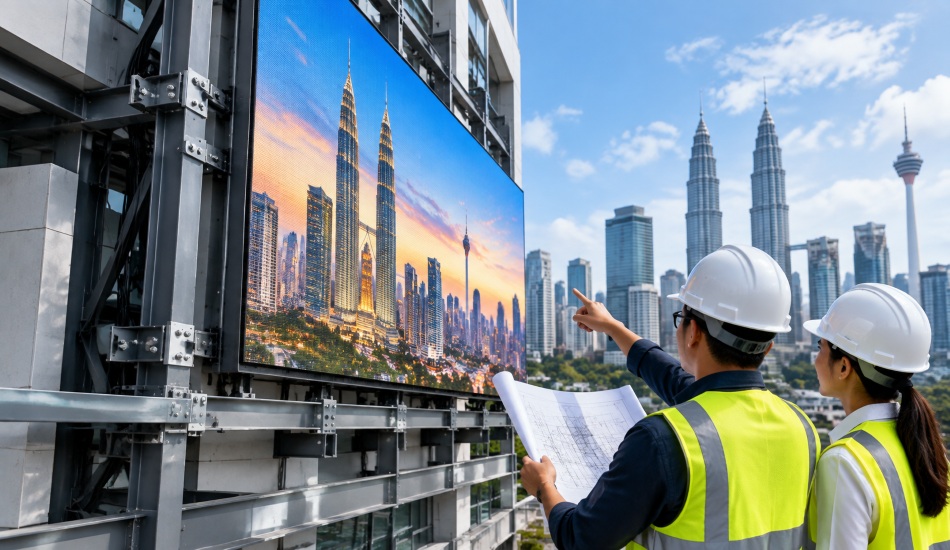
In May 2026, a large billboard came down across the Besraya Highway during a storm, tilting under strong wind before falling across the road. No vehicles were hit and nobody was hurt, but the video went viral, and it reopened a question that comes up after almost every one of these incidents: who is actually checking that these structures can handle Malaysia’s wind and rain, and when.
Our licence guide covers what documents your council wants before approving an LED billboard or digital signboard. This guide covers the engineering behind those documents. Getting the paperwork right matters. Getting the structure right is what actually keeps the screen standing.
The standard behind the paperwork: MS 1553
Malaysia’s wind loading requirements come from MS 1553, formally the Code of Practice on Wind Loading for Building Structure, published by the Department of Standards Malaysia (JSM) and developed with input from CIDB, JKR, the Institution of Engineers Malaysia and several universities. It sets out how engineers calculate the wind force a structure must withstand, based on location, height, exposure, and the structure’s shape.
A large-format LED screen behaves differently from a building wall in wind. It’s a flat, often elevated panel with nothing to break the airflow, which is precisely the geometry MS 1553’s shape factor calculations are built to handle. The standard also sets a basic design wind speed for Peninsular Malaysia, based on a 50-year return period and varying slightly by zone, that engineers use as the starting point for any structural calculation. Structures with a natural frequency below 1Hz, including tall, slender freestanding billboard poles, require a more detailed dynamic analysis rather than the simplified method.
MS 1553 compliance is technically voluntary as a standard, since Malaysian Standards operate that way by default. In practice, it becomes mandatory the moment a local council requires structural plan approval as a condition of your advertising licence, which is exactly what DBKL, MBPJ, MBSA and MPS all do for outdoor displays. As the Besraya incident showed, the standard existing on paper and a structure actually being checked against it before and after installation are two different things. Enforcement sits with local councils, and there’s no single national body that re-inspects approved structures on an ongoing basis.
Who’s allowed to certify the structure?
Structural plans for an LED billboard need to be signed off by a Professional Engineer registered with the Board of Engineers Malaysia (BEM), the statutory body that registers and regulates engineers under the Registration of Engineers Act 1967. A Professional Engineer’s stamp on a structural drawing means a qualified person has taken responsibility for the calculations, not just reviewed a template.
This matters more than it might seem. Given how routine LED screen installation has become, it’s easy to treat the structural drawing as a formality needed to satisfy a council checklist. In reality, it’s the one document in the whole application that actually determines whether the structure will hold under real wind loading, not just whether the paperwork is complete.
What a proper structural submission includes
A structural sign-off is more than a single stamped drawing. A complete package typically includes:
- A wind load calculation, showing the design wind pressure used and how it was derived from MS 1553
- Structural drawings showing the frame, mounting points, and foundation or anchor details
- Material specifications, including grade and thickness for any structural steel or aluminium used
- Foundation or anchor design, calculated for the specific soil or substrate at the site, not a generic template
- For larger freestanding structures, a geotechnical assessment of the foundation ground
Ask to see this package before installation, not just the final council approval. A council approving your application confirms the paperwork is complete. It doesn’t independently re-verify the engineering behind it, so the responsibility for sound calculations sits with the Professional Engineer named on the drawing, and with whoever chose to hire them.
Mounting method changes the engineering
How a screen is mounted has a bigger effect on structural requirements than its size alone.
- Wall or façade-mounted. Fixed directly to a concrete wall, column, or reinforced façade. This is the most common method for building-integrated screens, but it shifts real load onto the building’s own structure, so the anchor design and a structural check of the substrate itself both matter, not just the screen’s own frame.
- Rooftop. Elevated installations catch significantly more wind than a screen at street level, and rooftop mounts often need a more detailed engineering review for that reason, plus consideration of the roof structure’s own load capacity.
- Freestanding. Independent poles or gantry structures carry the full wind load themselves, with no building to share it with. These are the structures most often involved in collapse incidents like the one on the Besraya Highway, and they’re where dynamic analysis is most likely to be required if the structure is tall and slender.
Each method also affects your licence application differently. DBKL, for instance, requires Public Liability Insurance for outdoor displays regardless of mounting type, but a freestanding structure on public or roadside land typically draws more scrutiny than a screen mounted flush on a private building.
Materials and corrosion in Malaysia’s climate
Malaysia’s combination of year-round humidity, intense UV and, for coastal or industrial sites, salt spray makes material choice a structural decision, not just a cosmetic one.
Aluminium cabinets are common for outdoor LED displays because aluminium forms a self-protecting oxide layer when exposed to air, resisting corrosion without the repainting steel structures eventually need. Marine-grade alloys hold up better long-term than lower grades, and coastal or near-coastal installations are where that difference shows up fastest.
One detail worth knowing if your supplier mixes materials: mounting an aluminium cabinet directly onto galvanised steel framing without an insulating layer between them can cause galvanic corrosion, where contact between the two metals accelerates deterioration of the aluminium. It’s a completely avoidable problem with the right hardware, but it’s also easy to miss if structural design and cabinet selection are handled by different people without coordination.
Public Liability Insurance: what it actually covers
Several councils, including DBKL, require a Public Liability Insurance policy, commonly at least RM1 million, before approving an outdoor display licence. This isn’t a bureaucratic add-on. It covers third-party injury or property damage if something does go wrong, which is exactly the scenario every billboard collapse story on the news represents. Given that liability after an incident can fall on the display owner, the property owner, or the installer depending on the circumstances, confirming who holds this policy, and that it’s current, is worth doing before installation, not after an incident, which makes it urgent.
The gap between approval and ongoing safety
Structural approval happens once, at the point of installation. Malaysian weather, humidity, wind and the occasional structural stress from storms don’t stop after that. Coverage of the Besraya Highway collapse pointed to a real gap in the system: enforcement of structural requirements is delegated to local councils, and no national body conducts routine post-approval inspections of structures already standing.
That gap is exactly why periodic inspection is worth doing even when a council doesn’t explicitly demand it on a schedule. A basic structural and corrosion check, particularly after monsoon season or any major storm, catches loosening fixings, corrosion at contact points, or fatigue in welds long before they become the kind of failure that makes the news.
Building it right from the start
The safest, and ultimately cheapest, way to handle structural compliance is to build it into the installation from day one rather than retrofitting it after a council raises a question. Our outdoor LED display screens are engineered for Malaysian wind and weather conditions from the ground up, and our guide on choosing an LED screen supplier covers what to check before you commit to one. Browse our past installations or get in touch to talk through your site’s specific structural requirements.
Frequently Asked Question
What standard governs wind loading for LED billboards in Malaysia?
MS 1553, the Code of Practice on Wind Loading for Building Structure, published by the Department of Standards Malaysia. It sets out how engineers calculate wind force based on location, height and structure shape.
Who is qualified to certify a billboard’s structural plans?
A Professional Engineer registered with the Board of Engineers Malaysia (BEM). Their certification confirms a qualified person completed the structural calculations, not just that a form was filled in.
Does every LED screen installation need a structural engineer?
Not always for small, wall-mounted displays fixed directly to an existing structure. Large-format, elevated, freestanding, or rooftop installations almost always require it, and most local councils make it a condition of the outdoor display licence regardless of size.
Is MS 1553 legally required or just a recommendation?
It’s a voluntary Malaysian Standard by default, but it becomes an effective requirement wherever a local council requires structural plan approval as part of the advertising licence, which DBKL, MBPJ, MBSA and MPS all do.
How often should an installed LED billboard be inspected?
There’s no single national schedule, since post-approval inspection isn’t centrally enforced in Malaysia. Good practice is at least an annual check, plus an inspection after any major storm, focused on fixings, corrosion and any visible movement in the structure.
Does the mounting type affect my insurance requirement?
It can. Freestanding and rooftop structures generally carry more risk than a screen mounted flush on a building, and some councils factor this into their requirements. DBKL requires Public Liability Insurance of at least RM1 million for outdoor displays regardless of mounting type.
What should I ask my LED screen supplier about structural compliance?
Ask to see the wind load calculation, the Professional Engineer’s BEM registration details, and the material specifications for the frame and mounting hardware, not just a copy of the approved council licence. A licence confirms the paperwork was submitted. It doesn’t tell you whether the underlying engineering was done properly.


